
BY Mavis Paintsil
The National Population Council says Ghana has a unique opportunity to turn its youthful population into economic prosperity, but only if the country makes deliberate investments in health, education, jobs and youth participation now.
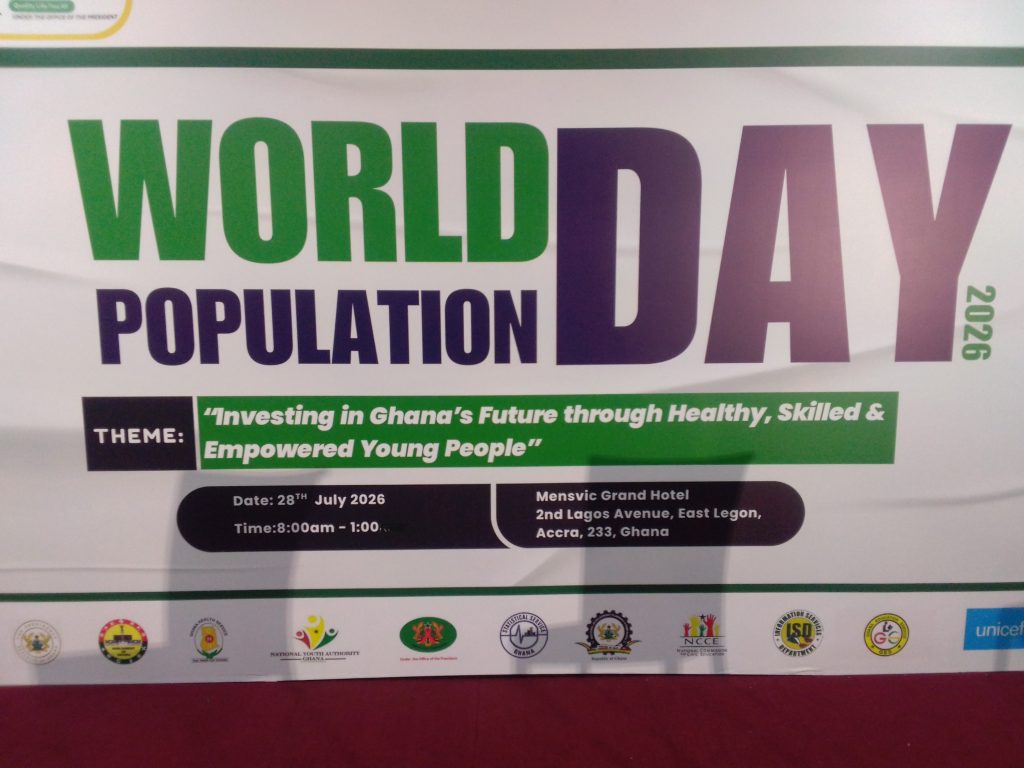
The call was made Tuesday, July 28, 2026, during the national commemoration of World Population Day at the Mensvic Grand Hotel, East Legon, under the theme “Investing in Ghana’s Future through Healthy, Skilled and Empowered Young People.”
The global theme for 2026 is “Realizing the Hopes and Aspirations of Young People: Today and for the Future.”
34.4 Million People, 12 Million Youth: “Greatest National Asset”
Delivering the address, Angelina Kabdua Nyanovi, Executive Director of the National Population Council, said Ghana’s estimated population of 34.4 million is “a source of pride and a shared responsibility.”
“Our youthful population is our greatest national asset, inspiring hope and collective effort to shape a brighter future,” she stated.
The Council noted that approximately 12 million Ghanaians are between the ages of 15 and 35, representing about 38 per cent of the population.
But Mrs. Nyanovi cautioned that numbers alone will not deliver development.
“A youthful population does not automatically produce a demographic dividend. The demographic dividend must be earned,” she said.
“It is earned when young people are healthy, receive quality education and skills that match the economy, have opportunities for decent work and entrepreneurship, and importantly, have a voice in decisions that shape their future.”
1.95 Million Youth Idle: Challenges Must Be Addressed
The Council highlighted urgent challenges holding back young people.
Citing 2025 labour statistics, she said approximately 1.95 million young people, or 19.5% of those aged 15-35, are Not in Education, Employment or Training. “This situation disproportionately affects young women,” she noted.
Other barriers listed include high unemployment and underemployment, skills mismatches, limited access to finance, adolescent pregnancy, and gaps in sexual and reproductive health information and services.
“These are not just youth issues. They affect the size and quality of our future workforce, household wellbeing, productivity, and ultimately the pace of Ghana’s development,” she said.
Priority Areas Outlined
The Council outlined 4 strategic priorities for action.
Health and Reproductive Well-being
“We must continue expanding access to quality sexual and reproductive health education, information, and services while equipping young people with life skills, including negotiation, decision-making, and self-confidence. Protecting young people’s health is an investment in Ghana’s future.”
Skills, Education and Innovation
“As economies become increasingly digital and knowledge-driven, our education and training systems must equip young people with digital competencies, technical expertise, entrepreneurial skills, creativity, and critical thinking.”
She cited Ghana Digital Centres, GI-KACE, TVET programs, and NEIP as key platforms to build on.
3. Decent Employment and Entrepreneurship
“This requires stronger public-private partnerships, improved access to finance for youth-led enterprises, and policies that stimulate youth employment and enterprise development.”
She referenced YEA, YouStart, Adwumawura National Apprenticeship Programme, Ghana Jobs and Skills Project, and NEIP.
4. Youth Participation in Decision-Making
“The future of Ghana cannot be designed without the meaningful participation of the young people who will inherit it,” she said.
Quoting the global principle, she added: “Nothing for Us, Without Us” must guide policy. She referenced the 4th National Adolescent Sexual and Reproductive Health Summit whose communiqué will inform future programs.
Government Commitment And Call To Action
The Council commended President John Dramani Mahama for prioritizing youth development.
“His Excellency President John Dramani Mahama has consistently emphasized that Africa’s future lies in its young people and that their voices must be reflected in policymaking,” Mrs. Nyanovi said.
She ended with a challenge to all stakeholders: “As we engage today, therefore, I invite us to consider one central question: What must we do differently, and at greater scale, to translate the potential of Ghana’s youthful population into tangible development gains?“
“Government alone cannot deliver the demographic dividend. It will require coordinated action across government, development partners, civil society, academia, communities and the private sector,” she added.
Addressing young people directly, she said: “And to the young people gathered here today, and the millions you represent across our country, this platform belongs to you. Your voices, aspirations, and concerns are vital to shaping our nation’s future.”
She concluded: “The future of our nation depends on the investments we make today and on the opportunities we create for the next generation to thrive.”
ghanaianannouncer
send invite to aba.mavis@gmail.com,or call 0505913033,0207697495
advert, sponsorship, news, partnership, church activities, graduation ceremony, birthday party,call 0505913033,0207697495
